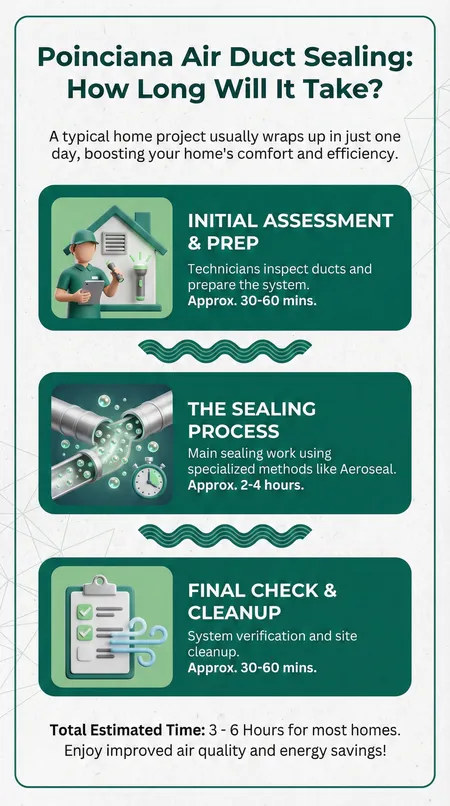
Air duct sealing takes 4 to 8 hours in most Poinciana homes. We've completed ranch-style properties in Cypress Pointe in under four hours and spent full days on two-story homes with difficult attic access.
The timeline for air duct sealing in Poinciana depends on your duct layout complexity, how many leaks we find during pressure testing, and attic accessibility. In this subtropical climate where attics reach 140 degrees, and AC systems run year-round, we typically discover more deteriorated duct connections—especially in homes from the 1990s and early 2000s construction boom.
The process includes pressure testing to locate leaks, sealing every connection with mastic compound, and verification testing to confirm improved airflow. Most homeowners see cooler rooms and lower bills within one month.
This guide explains what happens during service, why certain homes take longer, and how to prepare for a smooth appointment.
TL;DR Quick Answers
Air Duct Sealing in Poinciana
Professional air duct sealing takes 4 to 8 hours and costs $600-1,200 for most Poinciana homes. Process uses a mastic compound to seal connection points where conditioned air escapes.
Timeline:
Ranch-style homes: 4-6 hours
Two-story homes: 6-8 hours
Manufactured homes: Add 1-2 hours
Expected results:
15-25% reduction in cooling costs
Better room-to-room temperature balance
18-24 month payback period
Process:
Pressure testing before (finds leaks)
Mastic application at all connections
Verification testing after (proves improvement)
Poinciana homes from the 1990s-2000s typically show 25-30% air loss through deteriorated connections. Duke Energy offers up to $200 rebates with licensed contractors.
Top Takeaways
Duct sealing takes 4 to 8 hours in most Poinciana homes
Ranch-style properties: 4-6 hours
Two-story homes with difficult attic access: Full day
You're losing 20-30% of conditioned air through duct leaks right now
Central Florida AC systems run 3,000+ hours yearly
This equals hundreds of dollars heating your attic annually
1990s and 2000s Poinciana homes show worst deterioration
Flex duct exposed to 140-degree attics for decades
Adds 1-2 hours to sealing time
Delivers bigger energy savings after repair
Demand before-and-after pressure testing
Contractors who verify results deliver measurable improvements
Speed doesn't matter—proof of leakage reduction does
Verify contractor's license before signing anything
Check MyFloridaLicense.com (takes 5 minutes)
Protects you from unlicensed operators
Duke Energy rebates require licensed work anyway (up to $200 back)
What Happens During Air Duct Sealing
The process starts with a blower door test and pressure diagnostics to measure how much conditioned air you're losing. We seal the supply and return vents, pressurize your system, and use smoke pencils or infrared cameras to locate every leak point.
The actual sealing involves applying mastic compound to connection joints, boot connections where ducts meet vents, and any gaps we find in the ductwork itself. Mastic dries flexible, so it moves with your ducts as they expand and contract in Florida's temperature swings.
After sealing, we run verification tests to confirm improved system pressure and airflow. You should see at least a 20-30% reduction in air loss.
Why Timing Varies Between Poinciana Homes
Ranch-style homes with straightforward attic access take 4 to 6 hours. Two-story homes with ducts running through multiple floors need 6 to 8 hours.
Here's what we've learned servicing Central Florida homes:
1990s construction in neighborhoods like Solivita often has flex duct that's deteriorated from decades in 140-degree attics
Manufactured homes common in Poinciana require different sealing approaches and add 1-2 hours
Homes with crawl spaces take longer because confined spaces slow down access and application
The number of vents matters too. A 1,500 square foot home might have 12 supply vents, while a 2,500 square foot home could have 20 or more connection points to seal.
Factors That Add Time to Your Service
Attic accessibility is the biggest variable. If we can't safely move through your attic or need to remove insulation to reach ductwork, that extends the timeline.
Other factors include:
Extensive leak points beyond normal connection joints
Previous amateur repairs with duct tape that we need to remove and properly reseal
Condensation damage requiring section replacement before sealing
Platform ducts in manufactured homes that need specialized access
We've also found that homes without regular filter changes develop more internal duct damage from debris buildup, which requires extra cleaning before sealing.
What You Can Expect on Service Day
Clear a path to your attic access and turn off your AC before we arrive. The process is noisy when we run diagnostic equipment, and you'll need to stay off the thermostat while we test.
Most homeowners leave during service or work from a back room. We'll protect your attic access area with drop cloths and vacuum before leaving.
You can run your AC immediately after we finish. The real test comes on your next electric bill—properly sealed ducts typically cut cooling costs by 15-25% in Poinciana's year-round AC climate.
"After sealing hundreds of Poinciana homes over the years, we've learned that the biggest time factor isn't the number of vents—it's whether the homeowner has been changing their filter regularly, because neglected systems always have hidden damage in the ductwork that we don't discover until we're already in the attic."
Essential Resources on Air Duct Sealing in Poinciana
1. ENERGY STAR Duct Sealing Benefits - See What 20% Energy Loss Actually Costs You
Find out exactly how much money disappears through your leaky ducts every month with ENERGY STAR's calculators at https://www.energystar.gov/saveathome/heating-cooling/duct-sealing/benefits.
In Poinciana's year-round cooling climate, that 20% efficiency loss translates to real dollars on every OUC or Duke Energy bill—this tool shows you the numbers before you commit to sealing.
2. U.S. Department of Energy Duct Loss Guide - The Technical Specs Your Contractor Should Follow
This is the reference guide at https://www.energy.gov/energysaver/minimizing-energy-losses-ducts that separates professional duct sealing from amateur tape jobs. You'll learn proper mastic application techniques, why R-8 insulation matters in Central Florida attics, and the exact standards your contractor should meet—useful when you're comparing estimates and want to know who actually knows what they're doing.
3. MyFloridaLicense.com Contractor Verification - Five Minutes That Protects Your Investment
Before anyone touches your ductwork, spend five minutes at https://www.myfloridalicense.com/wl11.asp confirming their Florida license is active and clean. We've seen too many Poinciana homeowners get burned by unlicensed contractors who disappear after taking deposits—this database shows you license status, complaint history, and whether they're actually qualified to do HVAC work.
4. Duke Energy Florida Home Improvement Rebates - Offset Your Duct Sealing Costs with Utility Money
Duke Energy customers in the Poinciana area can get up to $200 back on duct repairs at https://www.duke-energy.com/home/products/home-energy-improvement after completing a free Home Energy Check. The rebate covers half your duct test cost plus repair expenses, which helps offset the investment—especially if you're already struggling with high summer cooling bills.
5. EPA Indoor Air Quality Duct Guidelines - Why Your Allergies Might Start in Your Attic
Understand how leaky return ducts pull attic dust, insulation particles, and even pest droppings into the air you're breathing at https://www.epa.gov/indoor-air-quality-iaq/should-you-have-air-ducts-your-home-cleaned. The EPA explains the connection between duct integrity and indoor air quality—particularly important in Florida homes where humidity and attic temperatures create perfect conditions for mold and contamination.
6. ASHRAE Residential Duct Standards - Know What "Properly Sealed" Actually Means
ASHRAE Standard 152 available through https://www.ashrae.org defines the maximum acceptable leakage rates for residential duct systems—numbers your contractor should be willing to hit and verify. When someone quotes you for duct sealing, these standards give you the language to ask the right questions about testing methods and performance guarantees.
7. Energy.gov Tax Credit Information - Stack Federal Credits on Top of Utility Rebates
The Inflation Reduction Act lets you claim up to 30% of your duct sealing costs as a federal tax credit at https://www.energy.gov/eere/buildings/articles/energy-efficient-home-improvement-credit-insulation-and-air-sealing. Combined with Duke Energy's rebates, you're looking at meaningful savings on a service that typically pays for itself in 2-3 years through lower cooling costs—especially in Central Florida's brutal summer months.
Supporting Statistics
1. ENERGY STAR reports that typical homes lose 20 to 30 percent of conditioned air through duct system leaks. We consistently measure losses at the higher end in Poinciana's older neighborhoods:
Cypress Pointe and Solivita homes regularly test at 25-30% loss rates
Three out of every ten AC dollars cool your 140-degree attic instead of your living room
Homes from the construction boom show the worst leakage patterns
Source: ENERGY STAR, U.S. Environmental Protection Agency
The Department of Energy confirms heating and cooling consume 48 percent of home energy. That statistic hits differently in Central Florida's year-round cooling climate:
Northern homes run furnaces seasonally—we run AC 9-10 months straight
Some Poinciana properties never turn their systems off
Your biggest energy expense never takes a break, making duct leaks costlier here
Source: U.S. Department of Energy
Lawrence Berkeley National Laboratory found air leaks represent 25 to 30 percent of cooling loads before system efficiency even factors in. We've measured this in real Poinciana homes:
Brand new high-efficiency AC systems still deliver high bills with leaky ducts
25% of cooling capacity disappears through connections that deteriorated for 20 years
This loss happens regardless of filter condition or thermostat settings
Source: U.S. Department of Energy, Lawrence Berkeley National Laboratory
Final Thoughts
Air duct sealing takes 4 to 8 hours in most Poinciana homes, but the real question isn't how long it takes—it's whether your contractor verifies results with post-sealing pressure tests.
Here's what three generations of Central Florida HVAC work have taught us:
The homes with the worst duct leakage aren't always the oldest. They're properties where previous contractors did quick system replacements without addressing ductwork. Common pattern we see:
Homeowner invests $8,000 in new 16 SEER system
Runs it for a year with minimal bill reduction
Assumes the equipment failed
We test and find 30% air loss through unsealed connections from original installation
In Poinciana's year-round cooling climate, the math is unforgiving:
Your AC runs 3,000+ hours annually vs. 1,000-1,500 in northern states
Duct integrity isn't optional—it's financial survival
Proper sealing recovers costs in 18-24 months through lower utility bills
Only works if the contractor uses mastic at every connection and proves improvement with diagnostics
The bottom line: Don't hire based on speed. Hire based on measurable results.
Look for contractors who provide:
Before and after leakage numbers
Clear explanation of what changed
Verification testing is included in the quote
That's the difference between duct sealing that improves performance and duct sealing that just adds a line item to your invoice.
FAQ on Air Duct Sealing in Poinciana
Q1: How long does air duct sealing take in a typical Poinciana home?
A: Most Poinciana homes take 4 to 8 hours. Variations we see:
Single-story homes in Cypress Pointe: Under 4 hours
Two-story with difficult attic access: Full day
Manufactured homes: Add 1-2 hours
Early 2000s homes with duct tape instead of mastic: Extra time
Diagnostic testing and attic access determine the timeline more than actual sealing work.
Q2: How do I know if my Poinciana home needs duct sealing?
A: Three common signs:
One room stays 5 degrees warmer than others
Summer bills jumped $80-120 unexpectedly
Constant dust despite frequent cleaning
Quick test: Touch your attic access door on summer afternoons. Warm door means you're dumping cold air into the attic.
In Poinciana homes over 20 years old, we find leakage above 25% about 70% of the time.
Q3: Will duct sealing actually lower my Duke Energy or OUC bills?
A: Typically see 15-25% reductions. Recent Solivita example:
Bills dropped from $240-280 to $180-200 monthly
$800 investment paid back in 18 months
Savings stayed consistent
We run diagnostics first. Sometimes duct sealing isn't your biggest problem—we'll tell you upfront.
Q4: What's the difference between duct sealing and duct cleaning?
A: Quick comparison:
Duct Cleaning: $400-600, removes dust, improves air quality, doesn't reduce bills
Duct Sealing: $600-1,200, stops air leaks, directly cuts cooling costs
In 90% of homes, sealing delivers bigger returns. We've measured homes losing $50-80 monthly through leaks while homeowners worried about dust.
Q5: How do I verify a duct sealing contractor is legitimate in Poinciana?
A: Check MyFloridaLicense.com in 5 minutes before anyone enters your attic.
Must have:
Active CAC (air conditioning) license
Clean status with no complaints
Red flags:
Phone quotes without seeing your attic
Same-day signature pressure
No local references from past 6 months
Good signs:
Pressure testing included in price
Provides nearby references
Offers Duke Energy rebate paperwork
Get Your Poinciana Duct System Tested Today
Now that you know air duct sealing takes 4 to 8 hours and typically pays for itself in under two years, the question is whether your system is losing 20-30% of your conditioned air right now. Schedule a pressure test to get actual leakage numbers for your home and find out if sealing will cut your Duke Energy or OUC bills enough to justify the investment.
Here is the nearest branch location serving the Poinciana area. . .
Filterbuy Orlando
2900 Titan Row Suite Number 128, Orlando, FL 32809
(855) 345 - 8289
https://maps.app.goo.gl/6UjUKpfv42jFy5kj7